THE SCIENCE OF THE CAMAR HIVE
Why We Built a Better Home for Bees
Finally, we have hives designed for both the BEES and HUMANS
Modern Hives are Neither Modern Nor Designed for Bees
They are a pre-Industrial Revolution invention—created in the early 1700s for human convenience—and they remain essentially unchanged today.
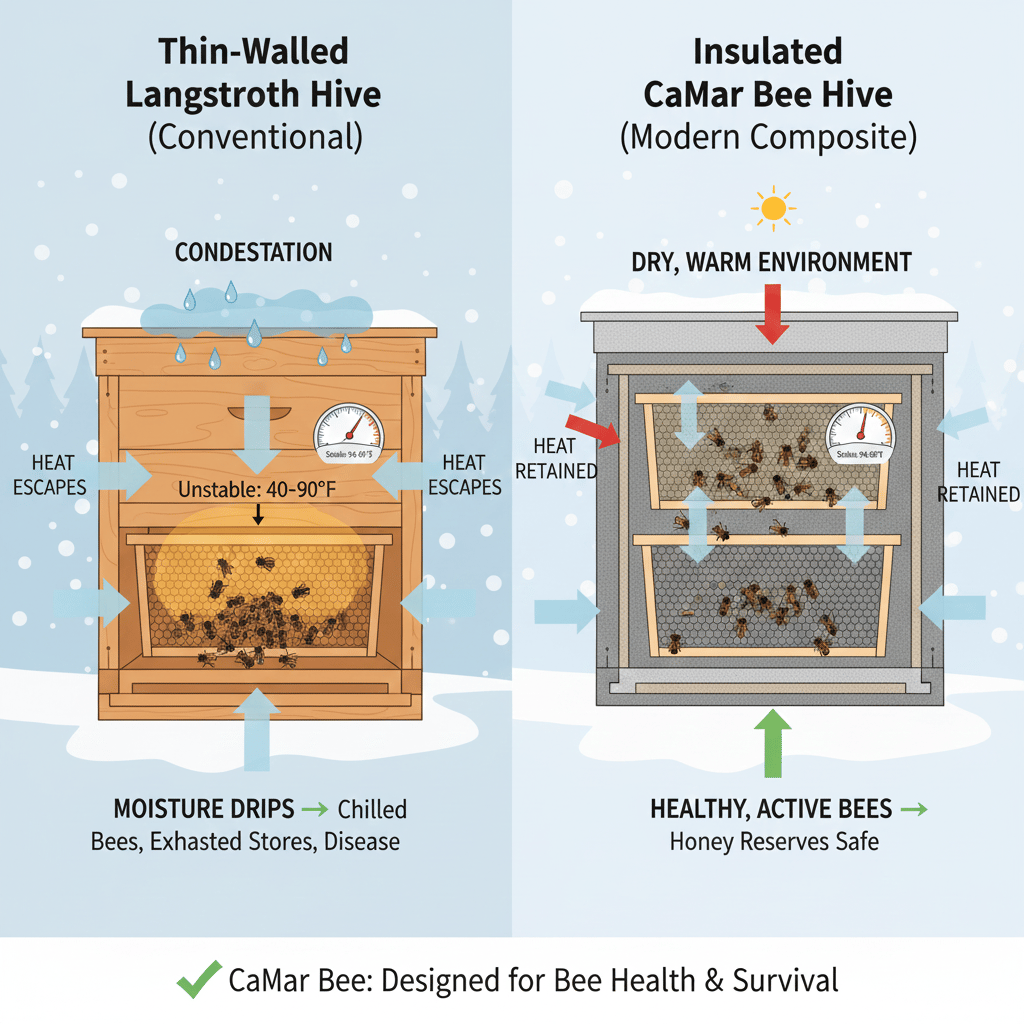
Bees evolved over 30 million years as forest-dwelling animals, living in hollow trees. In nature, a hive is protected by up to three feet of wood above it and with thick insulating walls. By contrast, today’s standard hive uses a top barely 3/8 of an inch thick—thin not because it benefits bees, but because it is easier for humans to handle.
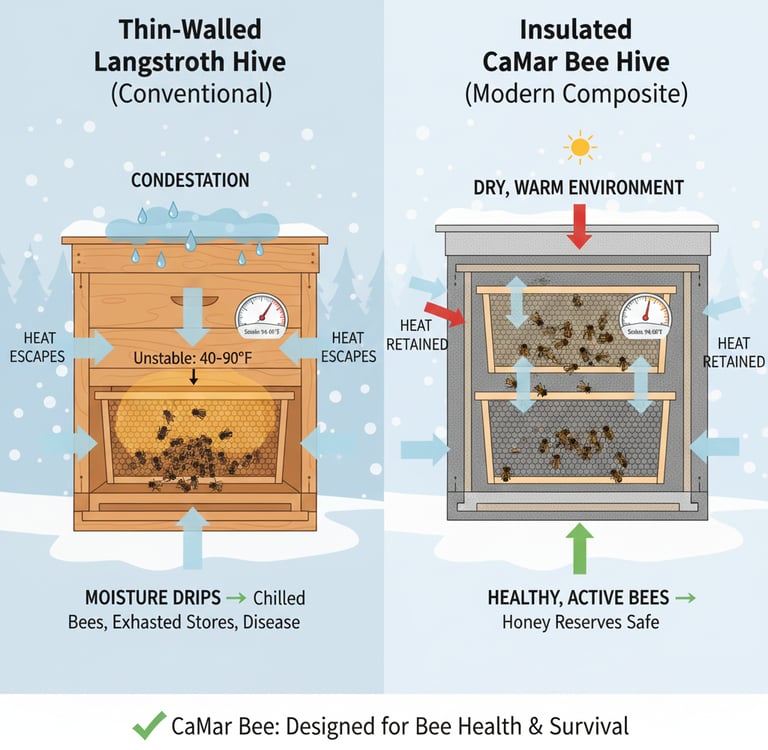
This design flaw has serious consequences. Bees maintain their hive at approximately 95°F and 60% humidity—a warm, moist environment. Warm air rises and, in thin-walled hives, hits cold surfaces, creating condensation. Moisture rains back onto the winter cluster, chilling the bees and creating an unhealthy environment. To survive, bees must constantly vibrate to generate heat, rapidly consuming their honey reserves. Unable to fly in cold weather, and after gorging themselves on honey, they eventually foul their nest, enabling bacteria and viruses to proliferate. This is a significant contributor to the catastrophic loss of Honeybees overwinter worldwide.
The CaMar Solution: Reverse-Engineering Nature
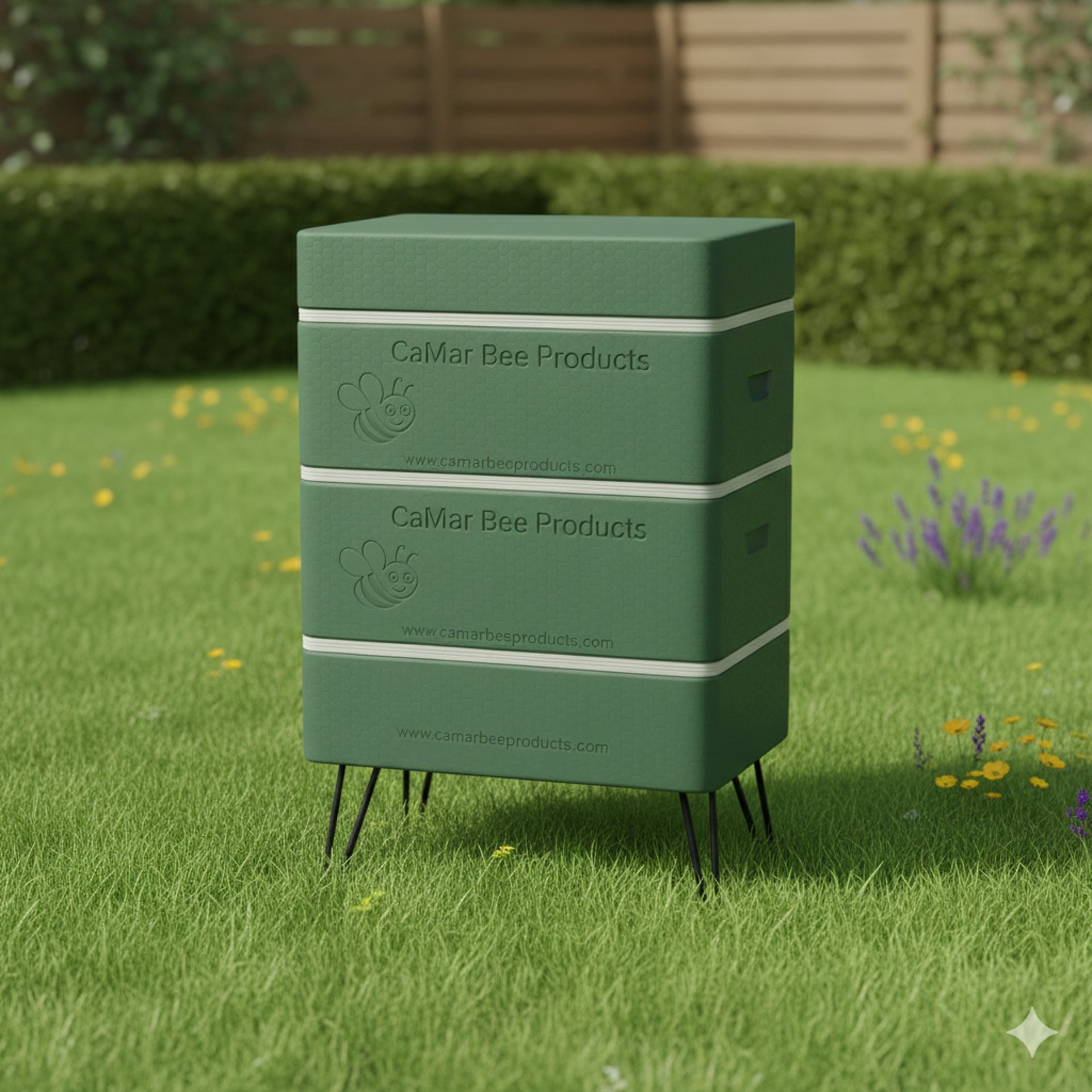
We set out to correct this by designing a hive for both bees and beekeepers. By reverse-engineering the insulation value—the R-value—of natural tree hollows, and after ten years of material research and composite development, we have created a hive system that restores the bees’ natural thermal environment. Finally, we have a hive designed for both the bees and for humans!
University Studies Confirm the Benefits of Insulated Hives
Studies consistently indicate a lower mortality rate of 20% and higher harvestable honey by 30%.
In parallel with our ten years of research, multiple university studies have confirmed the benefits of insulated hives. Polyethene-insulated hives, open-cell systems, are very good, but they are not UV-resistant and are not as durable as Polypropylene closed-cell composites. CaMar Bee Products’ Hive system is a composite PPE premium product that is UV-resistant and designed to last up to 25 years in the field. Wood boxes rot out decades earlier. Wooden hives are initially cheaper but more expensive in the long run because they don’t last.
References
1. United States Department of Agriculture / Bee Research Laboratory (USDA-ARS, Beltsville, Maryland) – USDA scientists (e.g., Alburaki & Corona) conducted a peer-reviewed comparative study showing that polyurethane insulated hives had more stable internal temperatures and optimal humidity compared with traditional wooden hives, indicating thermal benefits during winter conditions. ResearchGate+1
2. University of Illinois Urbana‑Champaign – Researchers including St. Clair et al. performed randomized field experiments showing that covered/insulated hives consumed less food stores and had higher overwinter survival rates than non-covered controls, indicating beneficial effects of hive insulation and overwintering covers. PMC
3. University of Leeds – A study from the School of Mechanical Engineering (Derek Mitchell) used thermofluid analysis to evaluate hive thermal properties and challenge assumptions about natural insulation behaviours, providing important foundational insights into hive thermal dynamics. Although this work is broader than direct insulation interventions, it is frequently cited in discussions of hive design and insulation effectiveness. University of Leeds
4. Yukon University – Yukon University researchers conducted a Hive Insulation Valuation Experiment comparing insulated and non-insulated hive types (including composite and polystyrene hives) with outcomes such as honey yield, brood area, and weight gain—providing quantitative data on benefits of thermally improved hives in colder climates. yukonu.ca
5. Latvian State Institute of Wood Chemistry (Not a traditional university but an institute closely collaborating with academic research) – This institute leads research projects focused on development of thermoreflective hive materials and environmentally friendly composite insulation combined with sensor monitoring to improve hive thermal microclimates and reduce winter losses, showing institutional research investment in hive insulation science. researchlatvia.gov.lv
These studies collectively address several aspects of the benefits of improving hive insulation and hive microclimate:
· Thermal performance: Polyurethane and other advanced materials improve internal temperature stability and humidity profiles compared with untreated wooden hives. ResearchGate
· Overwinter colony health: Field experiments indicate insulated or covered hives can reduce food consumption and mortality during overwintering. PMC
· Thermodynamics of hive environment: Engineering analyses help quantify heat loss in man-made hives versus natural nests, informing better insulation strategies. University of Leeds
· Insulation material evaluation: Quantitative comparisons of insulated versus non-insulated hives demonstrate impacts on brood production, honey storage, and weight gain. yukonu.ca
Innovative material research: Projects on new thermal insulation composites and reflective surfaces aim to improve microclimate control and colony resilience.researchlatvia.gov.lv
Ready to Build a Better Home for Your Bees?
You’ve seen the research. The CaMar Insulated Hive system is a durable, composite PPE product engineered to mimic a bee's natural tree hollow. Stop fighting condensation, poor insulation, and high mortality rates associated with traditional boxes. Invest in the long-term health and productivity of your colony today.
Experience the CaMar Advantage
Quality
Crafting beehives for thriving bee colonies worldwide.
Support
Shop
camarbeeproducts@gmail.com
© 2025. All rights reserved.